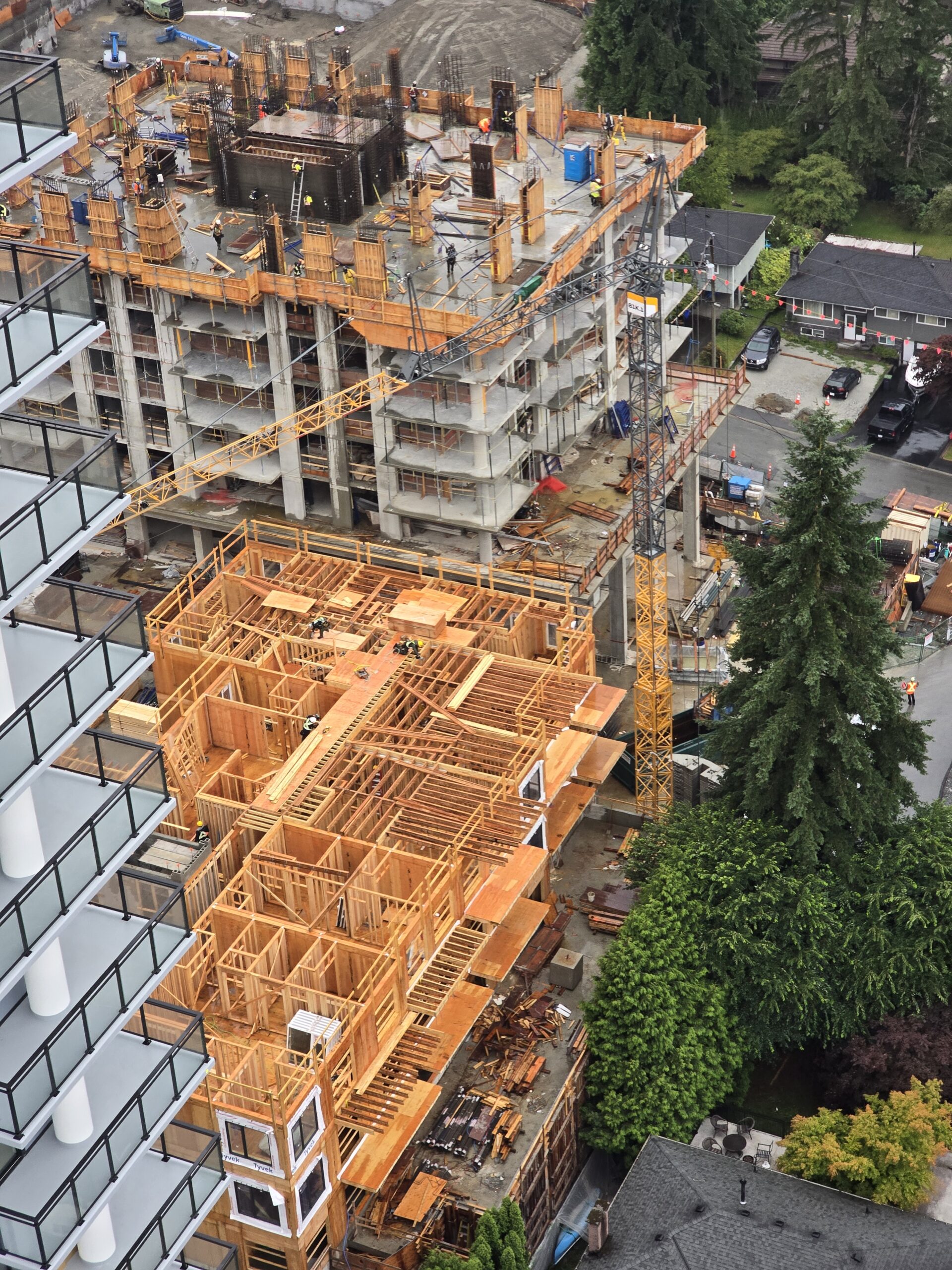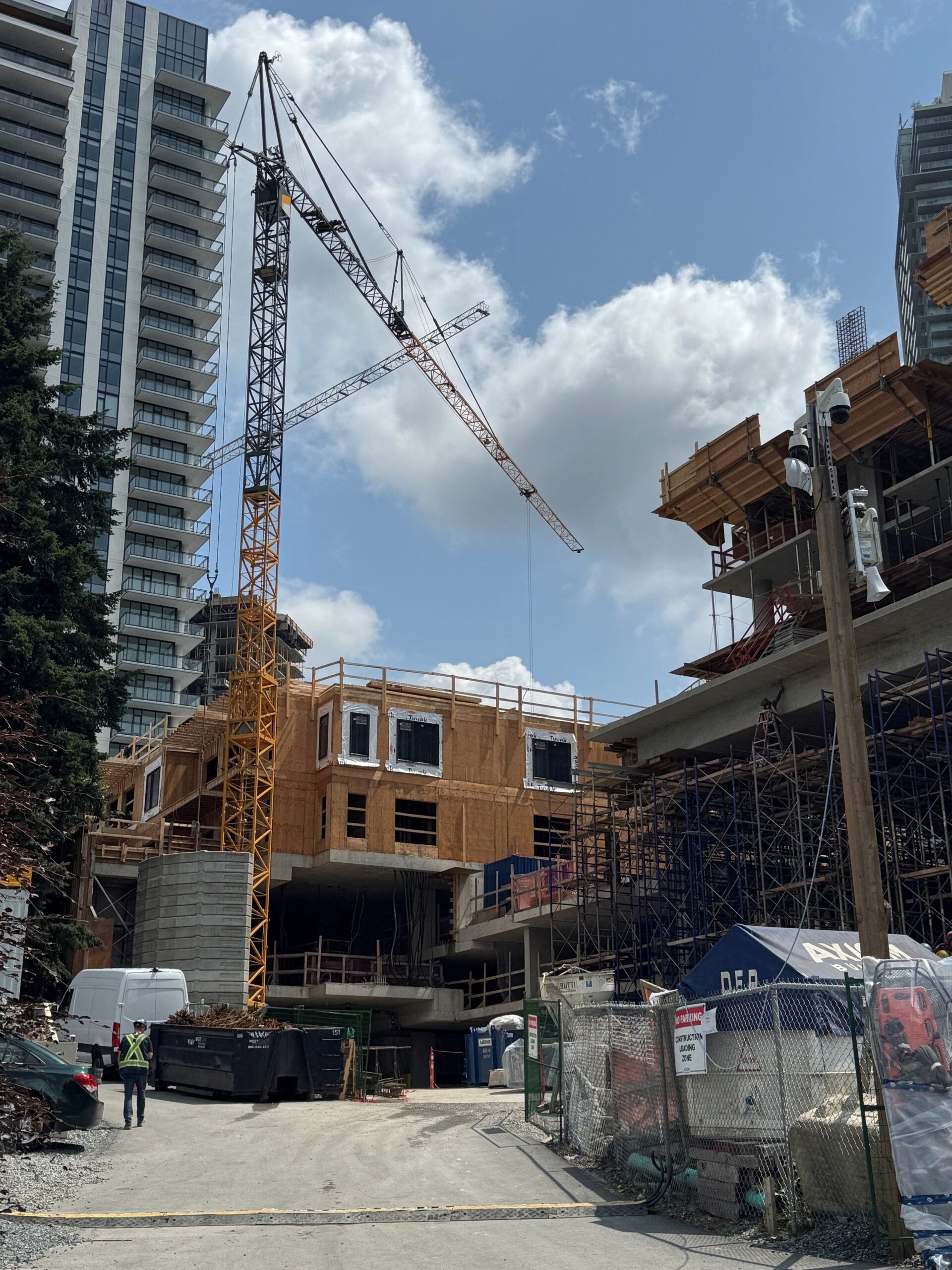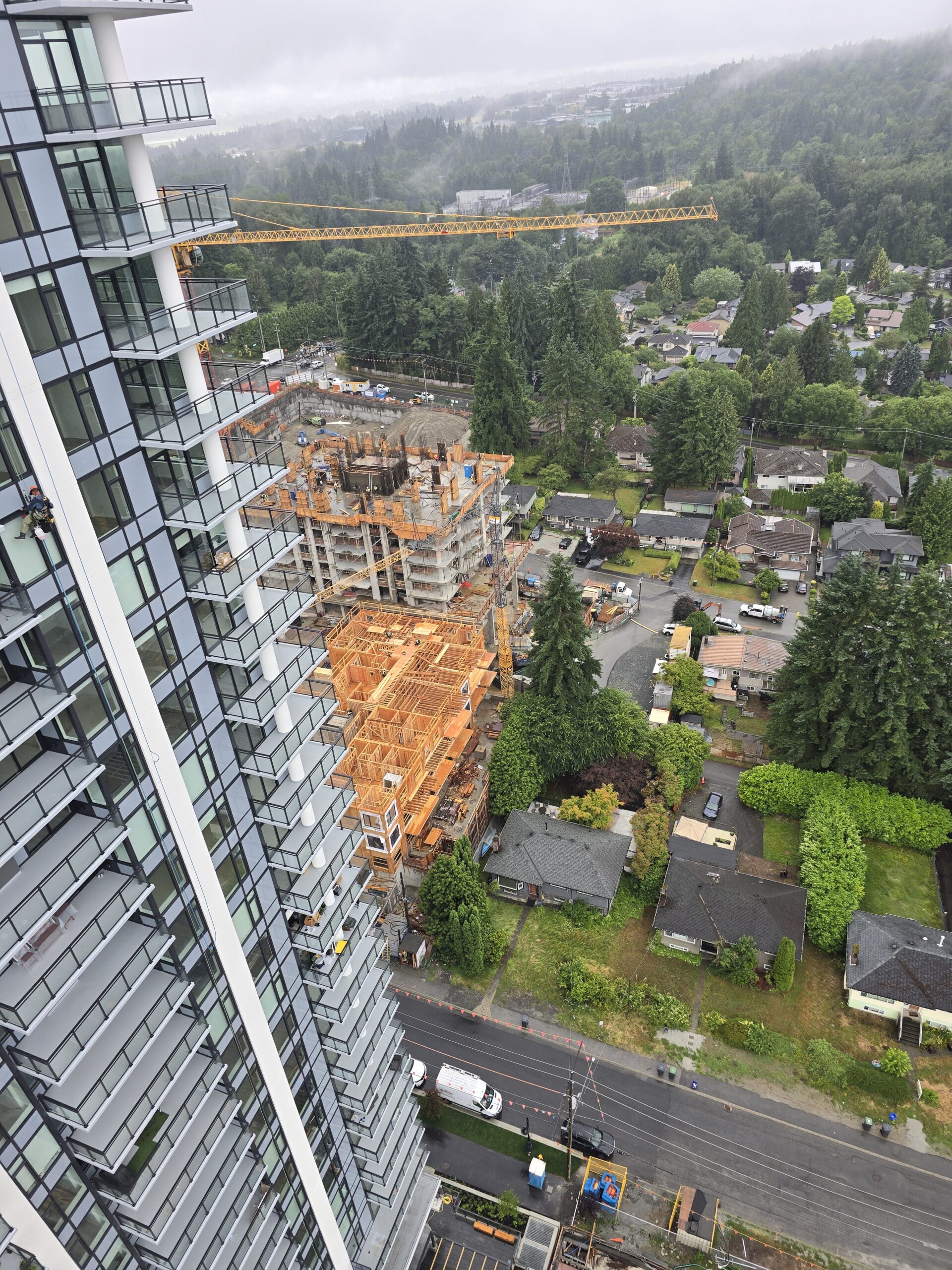

At the base of a 35-storey high rise in Coquitlam, BC, Bigfoot Crane Company deployed a Liebherr 81K.1 self-erecting tower crane in a challenging, space-constrained environment to erect Komo, a six-storey wood-frame building built by Legend Builders. The project demanded precision, flexibility and an innovative approach to crane setup, reach, and safety over four months.
Crane and Scope
The Liebherr 81K.1 was chosen for its compact footprint, internal climbing capability, and flexibility under demanding site conditions. Its role is to support full building envelope erection: timber framing, sheathing, floor panels, and material handling from delivery staging to onsite assembly.
The crane will be operational for approximately four months, working within a 90° swing arc inscribed between a high-rise structure on one side and a 32-meter canopy tree on the other. The 81K.1 must lift full lumber loads from trucks stationed on the upper street beyond the six-storey building.
Key Challenges and Innovative Solutions
Tight parkade corner setup
To preserve parkade access and maximize jib coverage of the future mid-rise, the crane had to be positioned in a corner of a suspended slab. Bigfoot Crane Company drove the 81K.1 onto the deck and then staged it in two outrigger positions. The client installed temporary reshoring beneath five floors of structure and re-shored two distinct outrigger set locations. A secondary 120-ton mobile crane then elevated the Liebherr 81K.1 from a folded configuration into the final corner slot.
Climbing past constraints
The crane was climbed internally using the climbing tower sections to 36 meters, high enough to pivot into the working zone between the high rise and the tree. This minimized interference with surrounding structures while giving full coverage to the six-storey footprint.
Extended reach demands
To reach lumber deliveries staged across the street, an extra 3 meter jib section was added (extending from 45 m to 48 m). Additionally, the Liebherr’s Load Plus mode allows up to 25 % additional capacity in first winch speed which was critical for tipping full lumber packs at distant radii without compromising cycle times.
Restricted swing and tie-down design
Because swing beyond 90° risks encroaching adjacent property or colliding with the high rise, the crane cannot weathervane at night without engineered restraint. The courtyard lacked space for conventional tie-downs. Liebherr provided a custom tie-down layout: the trolley was extended further along the boom to increase cable length, one anchoring end was cast into the courtyard slab, the other passed through a third-floor window in the tower to establish the required spread.
Anti-collision coordination
The Liebherr 81K.1 must operate in overlapping zones with the tower crane serving the high-rise. To manage this, both cranes are equipped with AMCS DCS-61 zoning and anti-collision systems that communicate in real time to enforce exclusion zones. Radio coordination supplements the safeguards to ensure operators never cross into a mutual interference zone.
Project Takeaway
This project exemplifies how the Liebherr 81K.1 from Bigfoot Crane Company, when supported by imaginative rigging and planning, can deliver in dense, restricted urban sites. The combination of internal climbing, extended jib, custom tie-downs, and anti-collision controls enables this 81K.1 to perform heavy lifts, full material delivery, and continuous operations all within a compact swing envelope. For constructors facing tight downtown footprints or overlapping crane territories, it demonstrates how Bigfoot Crane Company offers flexibility, safety and performance.